
 Encyclopedia
Gurus: facts and fables › Claims › T-WYS Case 01
Buy the open, win 54%? We tested it: no edge shown
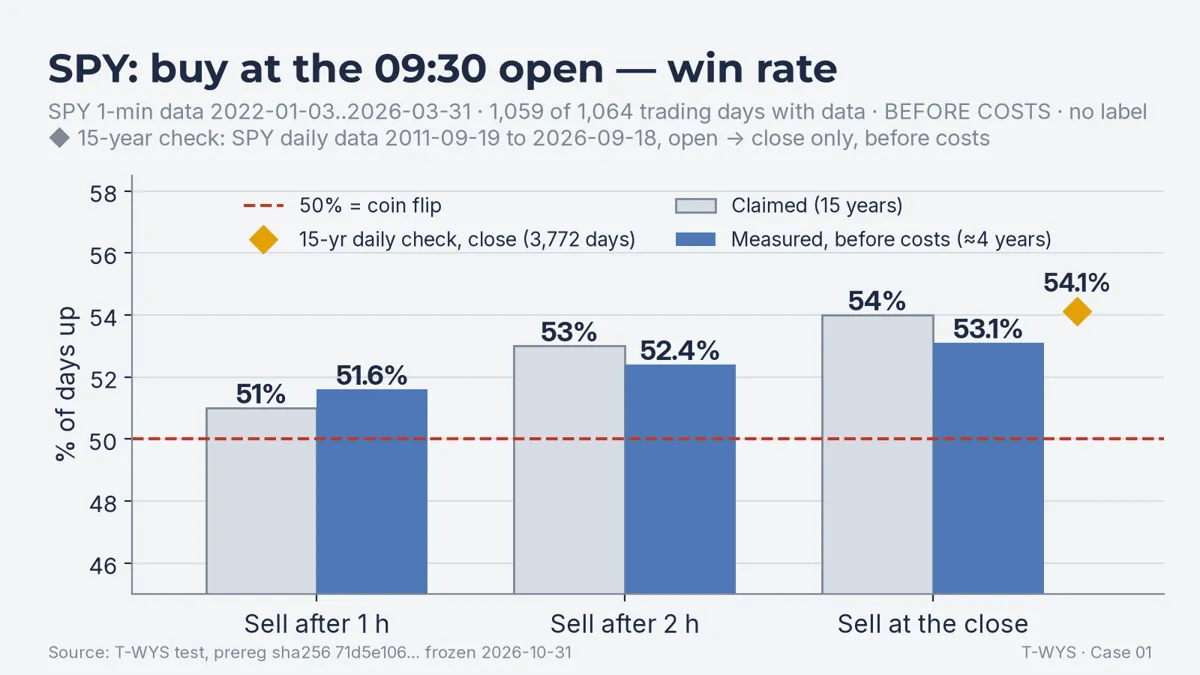
…if you just bought the SPY… at the open… sold it an hour later, you'd… win 51% of the time. 2 hours later, 53%. A full session at the end of the day, 54%.FAILED OUR TEST
— a trading podcast-style video, September 2026. We test the claim, not the person.
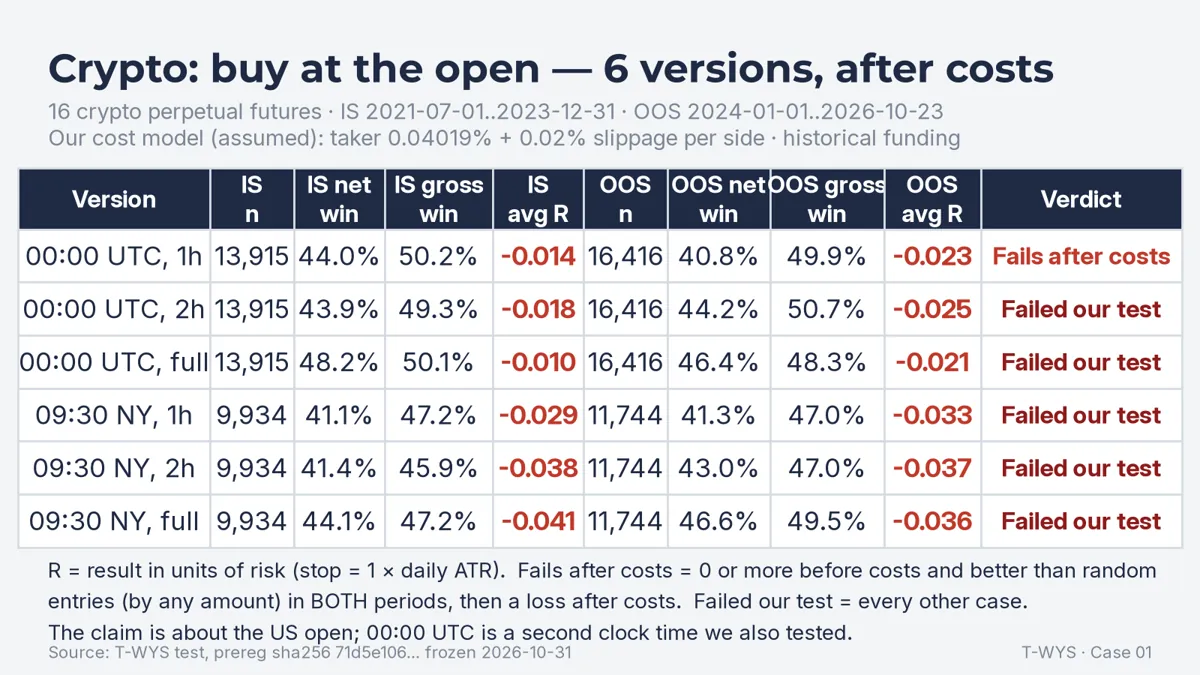
Crypto, at the US open (the claim's own time): FAILED OUR TEST. SPY: win rate roughly true, no edge shown (grey card, no stamp).
The numbers
The claim in kid language
Somebody said: buy SPY (a fund that follows the 500 biggest US companies) the second the market opens, sell later, and you win more often than you lose. Like a coin that lands heads a bit more than half the time.
What we did
SPY: 1-minute data from 2022-01-03 to 2026-03-31 (1,059 of 1,064 trading days with data), before costs. The claim talks about 15 years; we had about 4 years of 1-minute data. A second check used daily SPY data from 2011-09-19 to 2026-09-18, open to close only.
Crypto: 16 large crypto perpetual futures. Practice period 2021-07 to 2023-12, fresh period 2024-01 to 2026-10-23. Costs from our own cost model (assumed): taker 0.04019% + 0.02% slippage per side, plus historical funding rates. Every crypto trade was compared with 3 random entries.
Crypto never sleeps, so there is no real "open". We tested the clock time: 09:30 New York (the claim's time) and 00:00 UTC (a second clock time we also fixed in advance).
The main rules were written down and hashed before we saw any result (frozen 2026-10-31 18:54:01 UTC). A redacted copy of the preregistration is available (paths and third-party names removed). It is not the original frozen file, so no hash is shown. Small print: the time comes from our own computer, and two code files were changed 1–2 minutes after the freeze, before the first result.
What we found
SPY: the win rate was roughly what the claim said. But the average gain per day was too small to tell apart from zero. Winning often is not the same as winning money (see win rate).
Crypto at the US open: below zero even before costs, and worse than random entries in both periods. After costs, all six versions lost money. At 00:00 UTC, the 1-hour version was a hair better than random but still lost after costs. That side check does not change the verdict, because the claim is about the US open.
What we don't know
We had about 4 years of 1-minute SPY data, not 15. The SPY averages and the 15-year check were extra checks added later, not preregistered tests. Our cost model is an assumption. Backtests are hypothetical.
Open the SPY chart on TradingView
Open a Bitcoin chart on TradingView
Our crypto test used 16 crypto perpetual futures; the Bitcoin chart is a general view, not the exact data we tested. How links work.
Education only, not financial advice. No signals. Backtests are hypothetical: real trading can be worse. Past results don't predict future results.